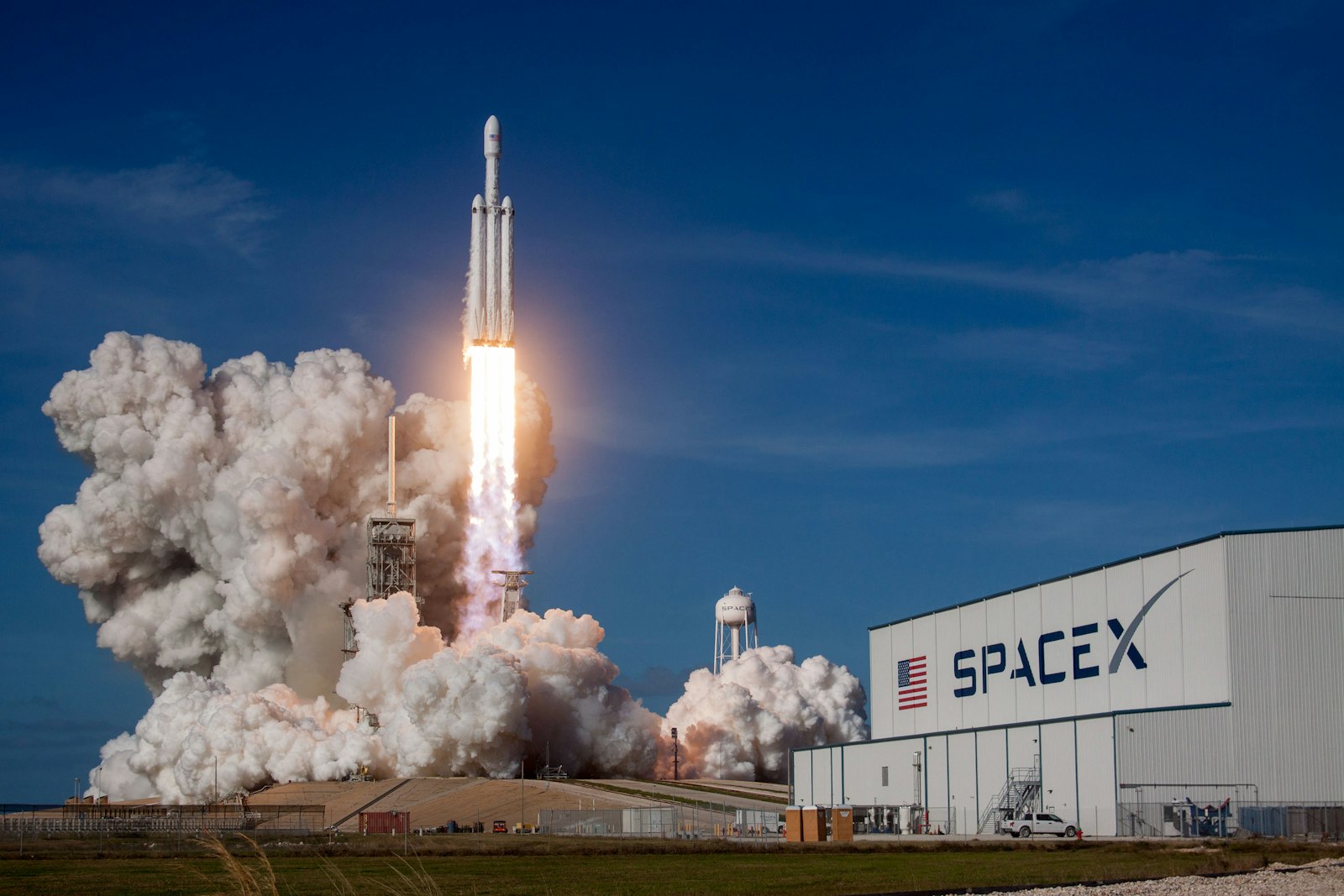
SpaceX is not the highest-paying space company. This one comes up so often it's worth just leading with. I've had the "how much does SpaceX pay?" conversation with candidates dozens of times, and the default assumption is always: obviously the most, right? Not really.
Here's what SpaceX is actually paying. 852 disclosed roles right now, median midpoint of $150K, P90 top of range at $230K. Both numbers sit slightly below the space-industry median. What SpaceX offers is real (and the equity, and the resume signal, and the six-month tender offer are separate topics) but the base cash is not where they compete.
I've been running a space jobs catalog for a few months and every disclosed salary band gets pulled directly from the company ATS. What follows is the shape of the market across 36 companies. I've flagged the specific numbers that surprised me, since those tend to be more useful than the ones you already expected.
One methodology note: ATS providers issue a separate requisition ID every time a role gets posted in a new city. "Senior Flight Software Engineer" in Hawthorne, Bastrop, and Cape Canaveral shows up as three ATS rows. All row counts below deduplicate by (company, title, city) so a role in a specific city counts once, not multiple times per requisition ID. Percentile calculations (median, P90) are done on the deduped set. Individual salary bands don't change with this fix — only the volume counts do.
The full picture
For companies that disclose on at least three postings:
| Company | Stage | Rows | Median mid | Top of band (P90 max) |
|---|---|---|---|---|
| Wayve (autonomy adjacent) | Series C | 50 | $268K | $384K |
| True Anomaly | Series B | 166 | $174K | $310K |
| Stoke Space | Series B | 43 | $191K | $328K |
| K2 Space | Series B | 126 | $162K | $250K |
| Vast | Series A | 118 | $159K | $266K |
| Anduril (space roles) | Series G | 195 | $183K | $290K |
| Muon Space | Series B | 45 | $192K | $252K |
| Slingshot Aerospace | Series A2 | 23 | $175K | $302K |
| Astranis | Series D | 42 | $169K | $235K |
| Relativity Space | Growth Equity | 246 | $157K | $246K |
| Sierra Space | Series B | 130 | $142K | $249K |
| Voyager Technologies | Public | 72 | $163K | $273K |
| Varda Space | Series B | 62 | $155K | $232K |
| SpaceX | Tender Offer | 852 | $150K | $230K |
| Rocket Lab | Public | 176 | $135K | $220K |
| Ursa Major | Series D | 36 | $135K | $232K |
| Loft Orbital | Series B | 31 | $161K | $215K |
| Planet Labs | Public | 40 | $159K | $231K |
| Spire Global | Public | 24 | $151K | $218K |
A few things stand out.
True Anomaly is the most interesting name in the top group. They're a Series B space-defense company in Denver and Long Beach, founded 2022, with 166 disclosed postings and a top of range at $310K. Their engineering roles pay in line with defense-tech unicorns like Anduril, which makes sense given the customer overlap.
Stoke Space is the number-two US launch company by comp range, above SpaceX and Rocket Lab. Their $328K P90 is driven by a small number of senior test lead roles at their Moses Lake, WA facility. If you're a propulsion test engineer looking at launch, they're worth talking to.
Vast, K2 Space, and Muon Space form a tight middle band. All Series B, all in the $160K-$200K midpoint, all with real top-of-band above $250K. These are the companies that are quietly paying up to fight for talent against the bigger names.
SpaceX pays market, not above market. This one always generates argument. The catalog is unambiguous: SpaceX's disclosed comp is at or slightly below the median of the space companies in this catalog. What they're paying for isn't cash. They're paying for equity in the form of tender offer liquidity every six months, plus the resume signal. Whether that's the right trade is up to you.
Anduril's space roles pay slightly above their overall robotics-and-defense average. That's driven by a small number of very senior positions (Head of Production, Rocket Motor Systems at $225K to $397K, for example). If you're a senior IC or engineering leader looking at space-defense, Anduril's numbers are competitive with any pure-play space company in this catalog.
Stage matters, but the pattern is different from robotics
Space industry pay bands compress at scale in a way robotics doesn't:
| Stage | Rows | P50 mid | P75 mid | P90 max |
|---|---|---|---|---|
| Series A | 126 | $165K | $185K | $258K |
| Series B | 603 | $161K | $195K | $286K |
| Series D | 78 | $151K | $179K | $234K |
| Growth Equity | 246 | $157K | $183K | $246K |
| Public | 312 | $145K | $167K | $240K |
| Tender Offer (SpaceX) | 852 | $150K | $163K | $230K |
Series B is again the sweet spot. The gap between Series B midpoint and Public midpoint is about $16K, which is small but consistent. Where the pattern is really different from robotics is at the very top of the stage ladder. Public space companies (Rocket Lab, Planet Labs, Spire, Voyager) pay noticeably less than public robotics unicorns like Aurora or Zoox. Part of this is that public space companies IPO'd earlier and smaller, so the "we're a real company now" comp bump hasn't fully arrived. Part of it is that space engineering leans harder into mission and mission-heavy companies typically underpay by 5-10% for a given level.
Level bands
| Level | Rows | Median min | Median max | P90 max |
|---|---|---|---|---|
| Senior | 944 | $140K | $200K | $260K |
| Executive / Principal | 356 | $135K | $190K | $292K |
| Lead / Staff | 1,037 | $116K | $170K | $234K |
| Mid | 297 | $105K | $150K | $190K |
| Entry | 18 | $100K | $120K | $173K |
Space industry senior comp lands about $30-40K below robotics senior comp at every percentile. That's real. It's not that space engineering is worth less. It's that space engineering has more experienced practitioners (many with decades in the industry via Boeing, Lockheed, LM, or Northrop) and the market has trained itself to expect ITAR-friendly domain experience as the default. Robotics is a younger industry with a smaller supply of "already knows the domain" candidates, so the premium there is higher.
The Executive P90 sitting higher than Senior P90 is the same pattern I saw in the robotics catalog. Executive at these companies often means Principal Engineer on an IC ladder, not VP.
By discipline
| Category | Median mid | P90 max |
|---|---|---|
| AI / ML | $163K | $300K |
| Software | $160K | $250K |
| Research | $158K | $249K |
| Testing | $157K | $253K |
| Autonomy | $155K | $253K |
| Hardware | $154K | $250K |
| Simulation | $150K | $252K |
| Controls | $148K | $250K |
| Robotics (in-space servicing, on-orbit manip) | $146K | $195K |
The bands here are much tighter than robotics. The delta between the top discipline (AI/ML) and the bottom (in-space robotics) is $17K on the median. If you're picking a specialty in space based on pay, don't. The pay differences are inside a single company's leveling ladder. Pick based on the physics you want to work on and the type of mission you want to fly.
Hardware being just $6K below software on the median is worth noting. Space is a hardware industry. The pay respects that.
Where the very top of the market is
A couple of outlier postings show max values in the $1-2M range (one Planet Labs Storage Infrastructure role at $2.2M, one Spire Global Federal Sales Director at $2M, one Stoke Space test lead at $1.5M). Those are legitimate. For the right specialist, a public satellite company or a fast-scaling launch startup will absolutely make an offer in that range. Not common, but real.
The more useful list is the top of the mid-market senior/director range across the space catalog:
- Wayve, Director AV Product Engineering: $440K to $580K (adjacent, but the catalog picks it up for autonomy-space overlap)
- Anduril, Head of Production, Rocket Motor Systems: $225K to $397K
- Anduril, Head of Production, Space: $291K to $386K
- True Anomaly, VP Platform Engineering: $185K to $390K
- True Anomaly, Principal Spacecraft Simulation Software Engineer: $230K to $390K
- Relativity Space, Director Hardware Engineering: $245K to $367K
- Relativity Space, Director Spaceport Infrastructure: $245K to $367K
- True Anomaly, Director Ground Software Engineering: $210K to $360K
- Slingshot Aerospace, Account Executive National Security: $150K to $370K
Directors and VPs at Anduril, Relativity, and True Anomaly are where the money is. Notice that none of these are launch-vehicle engineering roles. The top-paid space jobs right now are hardware production leadership, spacecraft software leadership, and government-adjacent commercial work.
Nobody in the space catalog is paying $500K+ base to a Principal Engineer. That's a real difference from the top of the robotics market, where Zoox and NVIDIA pay that regularly. Whether the equity picture at Anduril or True Anomaly makes up for it is a separate question that this data doesn't answer.
What to do with this
Three practical things.
Anchor your negotiation to the company's own posted range. If Vast has a $200K to $260K range published for a role, they have $60K of room. Ask.
If you're weighing SpaceX against a smaller Series B (K2, True Anomaly, Vast, Stoke), the cash comp is genuinely a wash or slightly in favor of the Series B. What tips the decision is equity design, tender offer frequency, and how much of a resume signal you want. The Series B companies typically offer more upside per share, more room to grow with the company, and no established six-month liquidity.
If you're at Boeing, Lockheed, or Northrop and considering a jump to new-space, expect base to hold roughly flat or bump 5-15% at Series B. The real gains are in equity, and equity is a separate math problem.
Methodology
Data pulled June 2026 from active job listings on MadeForSpace.io. Every listing is fetched directly from the employer's own ATS (Greenhouse, Lever, Ashby, or Workday) and includes the exact salary range the employer published. No scraping of secondary sites. No employee-reported estimates. Only US roles with both a min and a max disclosed.
If a company doesn't appear in the tables, they either don't disclose consistently or they have fewer than three current active listings with comp data.
Browse the full Made For Space catalog sorted by hiring velocity. If you're a company and something in your data looks wrong, email hello@madeforspace.io and we will fix it.
Next version of this data lands Q3. I'll add ITAR posture per company then, which is the follow-up question everyone asks.